The power of a man's virtue should not be measured by his special efforts, but by his ordinary doing.
--Blaise PascalSo, I decided the next best thing would be to make one myself.I picked a simple, learn-to-build kit from Guillow’s. The Fly Boy model. I made it a personal challenge to build it in the span of the three-day, two-night long weekend.Building the frame was probably the most satisfying part. Out of necessity, some of it has to be done in stages, but because you use either white glue or wood glue, the drying process is only a couple hours long, so several major steps can be accomplished in a single day. It becomes a very enjoyable day when you can say “I took some wood and turned it into something that looks like and airplane”. In reality, it was about 6 hours of effort to get the frame complete. For the wing, you take the ribs (the aerodynamically-shaped pieces that give the wing its lift), pin them on the plans vertically, then glue the spars onto them to hold everything in place, pinning them down as well to hold them tight. When dry, sand, and combine. The wing was made of 3 major sections, all of which could be built at the same time, and then later assembled when dry.Skinning the airplane is definitely a far more finicky and slow process. This model required tissue paper and diluted white glue to skin it, painted once on the frame, then again to the surface of the tissue paper that was touching the frame to ensure the glue penetrated all the way through the tissue paper and into the balsa wood frame. Again, this was a very stepwise process, but due to the diluted nature of the glue, it took a long time for the tissue paper to dry. The really neat part was that once you were done skinning, and the tissue was dry, if there were any wrinkles left in the tissue, lightly misting them with water would remove them when the water dried up. It basically tightened and stretched the imperfections out of the tissue paper.The wing was held in place by elastics and a dowel so you could move it forward and back to balance the airplane without having to commit to gluing it in place permanently. It also makes it easier to transport the airplane when you can take the big wing off.Threading the elastic through was definitely a test of patience. I ended up using a stretched-out coat hanger to help.For the first flight the instructions recommended only 25 turns of the elastic for wind up.Here’s the pitch! I think this was the exact point I realized that if it doesn’t work I may be left with a twisted pile of balsa wood, tissue, and a spinning propeller. And a weekend’s worth of wasted effort.Didn’t go far the first time, but it did survive the decent to the ground. I was amazed at how hard it hit and yet survived, unscathed.Later that day, when flying the airplane again, I lost count of the number of turns I had put into the propeller winding it up, and the elastic snapped. When it snapped, the elastic recoiled and spun around manically, tearing through the tissue paper. All of which was quickly and carefully cut out and replaced, which is pretty damn cool when you consider how easy it is to repair the airplane. So long as enough of it survives, it can always be fixed and re-flown, but it also served as a reminder of just how fragile flight can be. So remember, count your turns!
The airplane kit is on the table in front of us. We have the glue, the little wooden pieces, and the instructions. We work for hours putting together each piece, step by step. A dab of glue here, a clamp there, maybe some rubber bands to hold the bigger pieces together. We work slowly, allowing the glue to set overnight, even though we want to see it fly right now. We follow each step in order, even though we think we know how to do it on our own. Patience is the most important asset we bring to this activity - the willingness to allow each step its own time and proper place.
After we've done all the careful work and waited till the glue is firm, we take it out for a trial flight. It soars!
So do we, when we allow ourselves time to learn each step of the way.
You are reading from the book:@12Steps4Teens@ny911CanAngel@CaresLifeWisdomToday's Gift © 1985, 1991 by Hazelden Foundation. All rights reserved. Printed in the United States of America. No portion of this publication may be reproduced in any manner without the permission of Hazelden.
Online daily inspirationsRead a Thought for the Day from six of our most popular daily meditations books. They're posted online, every day, at hazeldenbettyford.org.
Managing your email subscriptions


Have an account on hazelden.org? Sign in now to manage your preferences.
Can't sign in? Send us an email to Change your email address. Unsubscribe from Today's Gift. Stop all Hazelden Betty Ford

https://sites.google.com/site/aaa12stepccounsellingcsociety/home... AAA 12 STEP CARING COUNSELLING CLINICAL SOCIETY-Above and Beyond AA - On Line- Life Coach for YOU & YOURS! 604- I have a Dream To Heal ALL Families Using=Fun,Laughter,Singing,Dance,Joy.Sharing Is Caring!! Forgiveness for Yourself and Yours = 70x7 = Unconditional Love! I feel, Religion Sells Guilt! You can Start Coda, Acoa Meetings =2People =Gods is There =BillW =Defrag Our ComputerHeadtalk
Monday, September 19, 2016
The power of a man's virtue should not be measured by his special efforts, but by his ordinary doing. --Blaise Pascal


Sunday, September 18, 2016
Seldom is a mistake as important as we allow it to be.
Every great mistake has a halfway moment, a split second when it can be recalled and perhaps remedied.
--Pearl S. Buck
--Pearl S. Buck
We make mistakes because we are human, we are imperfect, we are frequently out of touch with the rhythms of the moment. When our minds are one place, either still trapped by the past or in limbo due to fear of the future, we fail to revere the experience of the present. And only when we salute completely the moment do we respond accurately to its meaning.
Seldom is a mistake as important as we allow it to be. Always we can rechart our steps; never is a task completed without some modifications along the way. Perhaps we'd do well to consider all mistakes as simply modifications in the original plans. Corrections triggered by mistakes may well be responsible for better outcomes. In fact, mistakes may be part of the process necessary to keep our spiritual program focused. Their role in our lives may be of greater significance than we'd ever imagined. However, we shouldn't dwell on the mistake but, rather, on the remedy.
Today I'll have to modify my steps, probably a few times. And that's to be expected.
You are reading from the book:
The Promise of a New Day by Karen Casey and Martha Vanceburg
The Promise of a New Day by Karen Casey & Martha Vanceburg. © 1983, 1991 by Hazelden Foundation. All rights reserved. Printed in the United States of America. No portion of this publication may be reproduced in any manner without the permission of Hazelden.
Online daily inspirations
Today's Gift daily email meditation.Read a Thought for the Day from six of our most popular daily meditations books. They're posted online, every day, at hazeldenbettyford.org.
Today's Gift daily email meditation.Read a Thought for the Day from six of our most popular daily meditations books. They're posted online, every day, at hazeldenbettyford.org.
Visit the Hazelden Betty Ford Foundation Social Media site Like us on Facebook Join our YouTube channel Follow us on Twitter Learn more about us on LinkedIn Join us on Instagram Join us on PinterestJoin us on Google Plus
Managing your email subscriptions
Have an account on hazelden.org? Sign in now to manage your preferences.
Can't sign in? Send us an email to Change your email address. Unsubscribe from Today's Gift. Stop all Hazelden Betty Ford Foundation email.
To send us feedback, please email todaysgift@hazeldenbettyford.org
Hazelden Betty Ford Foundation, 15251 Pleasant Valley Rd., P.O. Box 11, RW19, Center City, MN 55012-0011, 800-257-7810
Please feel free to forward this email to a friend.
Subscribe to Today's Gift emails
Have our emails been recommended to you Sign up today to receive them at no charge. They're our daily gift to you.
Have an account on hazelden.org? Sign in now to manage your preferences.
Can't sign in? Send us an email to Change your email address. Unsubscribe from Today's Gift. Stop all Hazelden Betty Ford Foundation email.
To send us feedback, please email todaysgift@hazeldenbettyford.org
Hazelden Betty Ford Foundation, 15251 Pleasant Valley Rd., P.O. Box 11, RW19, Center City, MN 55012-0011, 800-257-7810
Please feel free to forward this email to a friend.
Subscribe to Today's Gift emails
Have our emails been recommended to you Sign up today to receive them at no charge. They're our daily gift to you.

Saturday, September 17, 2016
Surrender to the pain. Then learn to surrender to the good. It's there and more is on the way. --Beyond Codependency
Surrender to the pain. Then learn to surrender to the good. It's there and more is on the way.
--Beyond Codependency
--Beyond Codependency
Our goal in recovery is to make ourselves feel comfortable, peaceful, content, happy. We want to be at peace with ourselves and our environment. Sometimes, to do that, we need to be willing to face, feel, and get through discomfort.
I am not talking about being addicted to misery and pain. I am not talking about creating unnecessary pain. I'm talking about the legitimate discomfort we sometimes need to feel as we heal.
When we have surgery, the pain hurts most the day after the operation. When we do the kind of work we are facing in recovery, we are doing an emotional, mental, and spiritual surgery on ourselves. We're removing parts of us that are infected and inflamed.
Sometimes the process hurts. We are strong enough to survive discomfort and temporary feelings of emotional pain. Once we are willing to face and feel our discomfort and pain, we are almost to the point of release.
Today, I am willing to face my discomfort, trusting that healing and release are on the other side. Help me, God, be open to feeling whatever I need to feel to be healed and healthy. While I am doing this, I will trust I am cared for and protected by myself, my friends, my Higher Power, and the Universe.
You are reading from the book:
The Language of Letting Go by Melody Beattie
The Language of Letting Go © 1990 by Hazelden Foundation. All rights reserved. Printed in the United States of America. No portion of this publication may be reproduced in any manner without the permission of Hazelden.
Online daily inspirations
Today's Gift daily email meditation.Read a Thought for the Day from six of our most popular daily meditations books. They're posted online, every day, at hazeldenbettyford.org.
Today's Gift daily email meditation.Read a Thought for the Day from six of our most popular daily meditations books. They're posted online, every day, at hazeldenbettyford.org.
Visit the Hazelden Betty Ford Foundation Social Media site Like us on Facebook Join our YouTube channel Follow us on Twitter Learn more about us on LinkedIn Join us on Instagram Join us on PinterestJoin us on Google Plus
Managing your email subscriptions
Have an account on hazelden.org? Sign in now to manage your preferences.
Can't sign in? Send us an email to Change your email address. Unsubscribe from Today's Gift. Stop all Hazelden Betty Ford Foundation email.
To send us feedback, please email todaysgift@hazeldenbettyford.org
Hazelden Betty Ford Foundation, 15251 Pleasant Valley Rd., P.O. Box 11, RW19, Center City, MN 55012-0011, 800-257-7810
Please feel free to forward this email to a friend.
Subscribe to Today's Gift emails
Have our emails been recommended to you Sign up today to receive them at no charge. They're our daily gift to you.
Have an account on hazelden.org? Sign in now to manage your preferences.
Can't sign in? Send us an email to Change your email address. Unsubscribe from Today's Gift. Stop all Hazelden Betty Ford Foundation email.
To send us feedback, please email todaysgift@hazeldenbettyford.org
Hazelden Betty Ford Foundation, 15251 Pleasant Valley Rd., P.O. Box 11, RW19, Center City, MN 55012-0011, 800-257-7810
Please feel free to forward this email to a friend.
Subscribe to Today's Gift emails
Have our emails been recommended to you Sign up today to receive them at no charge. They're our daily gift to you.
Friday, September 16, 2016
Our work brings people face to face with love. --Mother Teresa
Our work brings people face to face with love.
--Mother Teresa
--Mother Teresa
Whether we are sowing a garden, tending the sick, role modeling for children, or climbing the corporate ladder, many opportunities are present for acting from a posture of love. Love is an attitude, one born from gratitude for all we have, all we are, and all we hope to be. We cultivate a loving outlook just as surely as we cultivate gardens and friendships.
The guilt or shame we sometimes feel prompts us to remember those moments when we were faced with the choice to love but failed to love - those times we barked answers, scowled at someone special, slammed drawers and doors. Fortunately, we need not be perfect. Each moment promises us a new opportunity to choose love as our response to the many people and the changing events in our lives.
Some decisions can be made once for all time. Using seat belts is such a decision. So is offering love to the world that greets us.
You are reading from the book:
Worthy of Love by Karen Casey
Worthy of Love by Karen Casey. © 1985 by Hazelden Foundation. All rights reserved. Printed in the United States of America. No portion of this publication may be reproduced in any manner without the permission of Hazelden.
Online daily inspirations
Today's Gift daily email meditation.Read a Thought for the Day from six of our most popular daily meditations books. They're posted online, every day, at hazeldenbettyford.org.
Today's Gift daily email meditation.Read a Thought for the Day from six of our most popular daily meditations books. They're posted online, every day, at hazeldenbettyford.org.
Visit the Hazelden Betty Ford Foundation Social Media site Like us on Facebook Join our YouTube channel Follow us on Twitter Learn more about us on LinkedIn Join us on Instagram Join us on PinterestJoin us on Google Plus
Managing your email subscriptions
Have an account on hazelden.org? Sign in now to manage your preferences.
Can't sign in? Send us an email to Change your email address. Unsubscribe from Today's Gift. Stop all Hazelden Betty Ford Foundation email.
To send us feedback, please email todaysgift@hazeldenbettyford.org
Hazelden Betty Ford Foundation, 15251 Pleasant Valley Rd., P.O. Box 11, RW19, Center City, MN 55012-0011, 800-257-7810
Please feel free to forward this email to a friend.
Subscribe to Today's Gift emails
Have our emails been recommended to you Sign up today to receive them at no charge. They're our daily gift to you.
Have an account on hazelden.org? Sign in now to manage your preferences.
Can't sign in? Send us an email to Change your email address. Unsubscribe from Today's Gift. Stop all Hazelden Betty Ford Foundation email.
To send us feedback, please email todaysgift@hazeldenbettyford.org
Hazelden Betty Ford Foundation, 15251 Pleasant Valley Rd., P.O. Box 11, RW19, Center City, MN 55012-0011, 800-257-7810
Please feel free to forward this email to a friend.
Subscribe to Today's Gift emails
Have our emails been recommended to you Sign up today to receive them at no charge. They're our daily gift to you.
Sunday, September 11, 2016
Letting go
Stop playing tug-of-war.
Letting go can be like a tug-of-war with God.
Have you ever played tug-of-war with a puppy and an old sock or a toy? He pulls. You pull it out of his mouth. He grabs hold again and shakes and shakes and says grrrrrr. The harder you tug, the harder the puppy tugs. Finally, you just let go. Then he comes right back again for more.
I have never successfully treated or solved one problem in my life by obsessing or controlling. I've yet to accomplish anything by worrying. And manipulation has not wrought one successful outcome. But I forget that from time to time.
The best possible outcomes happen when I let go. That doesn't mean I always get my way. But things work out and, ultimately, the lesson becomes clear. If we want to play tug-of-war, we can, but it's not an efficient problem-solving skill.
God, help me surrender to Your will.
Letting go can be like a tug-of-war with God.
Have you ever played tug-of-war with a puppy and an old sock or a toy? He pulls. You pull it out of his mouth. He grabs hold again and shakes and shakes and says grrrrrr. The harder you tug, the harder the puppy tugs. Finally, you just let go. Then he comes right back again for more.
I have never successfully treated or solved one problem in my life by obsessing or controlling. I've yet to accomplish anything by worrying. And manipulation has not wrought one successful outcome. But I forget that from time to time.
The best possible outcomes happen when I let go. That doesn't mean I always get my way. But things work out and, ultimately, the lesson becomes clear. If we want to play tug-of-war, we can, but it's not an efficient problem-solving skill.
God, help me surrender to Your will.
You are reading from the book:

Online daily inspirations
Read a Thought for the Day from six of our most popular daily meditations books. They're posted online, every day, athazeldenbettyford.org.
Read a Thought for the Day from six of our most popular daily meditations books. They're posted online, every day, athazeldenbettyford.org. 

Managing your email subscriptions
Have an account on hazelden.org? Sign in now to manage your preferences.
Can't sign in? Send us an email to Change your email address. Unsubscribe from Today's Gift. Stop all Hazelden Betty Ford Foundation email.
To send us feedback, please email todaysgift@hazeldenbettyford.
Hazelden Betty Ford Foundation, 15251 Pleasant Valley Rd., P.O. Box 11, RW19, Center City, MN 55012-0011, 800-257-7810
Please feel free to forward this email to a friend.
Subscribe to Today's Gift emails
Have our emails been recommended to you Sign up today to receive them at no charge. They're our daily gift to you.
Have an account on hazelden.org? Sign in now to manage your preferences.
Can't sign in? Send us an email to Change your email address. Unsubscribe from Today's Gift. Stop all Hazelden Betty Ford Foundation email.
To send us feedback, please email todaysgift@hazeldenbettyford.
Hazelden Betty Ford Foundation, 15251 Pleasant Valley Rd., P.O. Box 11, RW19, Center City, MN 55012-0011, 800-257-7810
Please feel free to forward this email to a friend.
Subscribe to Today's Gift emails
Have our emails been recommended to you Sign up today to receive them at no charge. They're our daily gift to you.
Friday, September 9, 2016
worry, we are ready to reverse the pattern. Progress, not perfection,
That the birds of worry and care
fly about your head
This you cannot change
But that they build nests in your hair
This you can prevent.
-- Chinese Proverb
Worry can light on our shoulders or sink its teeth into our flesh. Worry can become such a habit that it may actually take over most of our waking and dreaming hours. Worry can break down our immune system and weaken our natural ability to fight illness.
For some people, worry is a full-time job and life companion. How much do each of us worry each day? This is a good question to ask when we are ready to get serious about changing our worry habits.
Once we have identified how and when we worry, we are ready to reverse the pattern. Progress, not perfection, is the key in changing our worry habits. With an open mind and willing heart we have the power to change our habit of worry into one of trust. We know as we make this change that our Higher Power is truly at work in our lives.
Today let me begin to replace my worry with trust and faith in my ability to use my resources to face whatever life brings me.
fly about your head
This you cannot change
But that they build nests in your hair
This you can prevent.
-- Chinese Proverb
Worry can light on our shoulders or sink its teeth into our flesh. Worry can become such a habit that it may actually take over most of our waking and dreaming hours. Worry can break down our immune system and weaken our natural ability to fight illness.
For some people, worry is a full-time job and life companion. How much do each of us worry each day? This is a good question to ask when we are ready to get serious about changing our worry habits.
Once we have identified how and when we worry, we are ready to reverse the pattern. Progress, not perfection, is the key in changing our worry habits. With an open mind and willing heart we have the power to change our habit of worry into one of trust. We know as we make this change that our Higher Power is truly at work in our lives.
Today let me begin to replace my worry with trust and faith in my ability to use my resources to face whatever life brings me.
You are reading from the book:

Online daily inspirations
Read a Thought for the Day from six of our most popular daily meditations books. They're posted online, every day, athazeldenbettyford.org.
Read a Thought for the Day from six of our most popular daily meditations books. They're posted online, every day, athazeldenbettyford.org.
Managing your email subscriptions
Have an account on hazelden.org? Sign in now to manage your preferences.
Can't sign in? Send us an email to Change your email address. Unsubscribe from Today's Gift. Stop all Hazelden Betty Ford Foundation email.
To send us feedback, please email todaysgift@hazeldenbettyford.
Hazelden Betty Ford Foundation, 15251 Pleasant Valley Rd., P.O. Box 11, RW19, Center City, MN 55012-0011, 800-257-7810
Please feel free to forward this email to a friend.
Subscribe to Today's Gift emails
Have our emails been recommended to you Sign up today to receive them at no charge. They're our daily gift to you.
Have an account on hazelden.org? Sign in now to manage your preferences.
Can't sign in? Send us an email to Change your email address. Unsubscribe from Today's Gift. Stop all Hazelden Betty Ford Foundation email.
To send us feedback, please email todaysgift@hazeldenbettyford.
Hazelden Betty Ford Foundation, 15251 Pleasant Valley Rd., P.O. Box 11, RW19, Center City, MN 55012-0011, 800-257-7810
Please feel free to forward this email to a friend.
Subscribe to Today's Gift emails
Have our emails been recommended to you Sign up today to receive them at no charge. They're our daily gift to you.
Monday, August 22, 2016
We either became alcoholics (or practiced other addictive behavior) ourselves, or married them, or both.
Adultchildren
-Art Therapy Exercises and Therapy worksheetsThe Meadows of Wickenburg Az Presents:
John Bradshaw- Inner Child Deep Feeling Work
Art Therapy Exercises -http://www.therapistaid.com/therapy-worksheets/none/adults 100 Art Therapy Exercises - The Updated and Improved List ...
"The Healthiest Form of Projection is Art" (Fritz Perlz - GestaltTherapist) Here is a popular ... Finger painting isn't just fun for kids– adults can enjoy it as well.Bradshaw On: The Family.https://www.google.ca/webhp?tab=iw&ei=kGu7V97MMIKxeNCjvlA&ve d=0EKkuCAQoAQ#q=john+bradshaw+ the+family+youtube THE PROBLEM
Many of us found that we had several characteristics in common as a result of being brought up in an alcoholic or dysfunctional household. We had come to feel isolated and uneasy with other people, especially authority figures. To protect ourselves, we became people-pleasers, even though we lost our own identities in the process. All the same we would mistake any personal criticism as a threat. FailingWe either became alcoholics (or practiced other addictive behavior) ourselves, or married them, or both. that, we found other compulsive personalities, such as a workaholic, to fulfill our sick need for abandonment.We lived life from the standpoint of victims. Having an overdeveloped sense of responsibility, we preferred to be concerned with others rather than ourselves. We got guilt feelings when we stood up for ourselves rather than giving in to others. Thus, we became reactors, rather than actors, letting others take the initiative. We were dependent personalities, terrified of abandonment, willing to do almost anything to hold on to a relationship in order not to be abandoned emotionally. Yet we kept choosing insecure relationships because they matched our childhood relationship with alcoholic or dysfunctional parents.These symptoms of the family disease of alcoholism or other dysfunction made us "co-victims", those who take on the characteristics of the disease without necessarily ever taking a drink. We learned to keep our feelings down as children and kept them buried as adults. As a result of this conditioning, we confused love with pity, tending to love those we could rescue. Even more self-defeating, we became addicted to excitement in all our affairs, preferring constant upset to workable relationships.This is a description, not an indictment.Exploring Social Anxiety
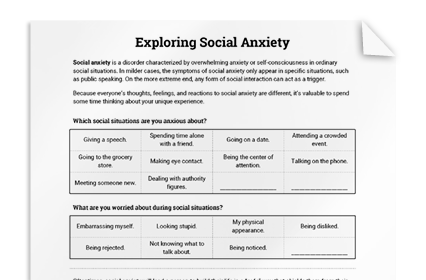
worksheetSocial anxiety is one of the most common mental disorders, with an estimated 6.8% annual prevalence among adults (NIMH). Its impact on a person's life can be far reaching. It's not uncommon for a person with social anxiety to shape their life decisions around their fears, while making major sacrifices in the process...Challenging Anxious Thoughts
worksheetThe Challenging Anxious Thoughts worksheet will teach your clients about the CBT concept of irrational and rational thoughts, as they relate to anxiety. Psychoeducation is interspersed with examples, and opportunities for your clients to write about their own experiences. Because irrational thoughts can be difficult to pin down without practice, we suggest working closely with your client as they make their way through this worksheet...Sleep Diary
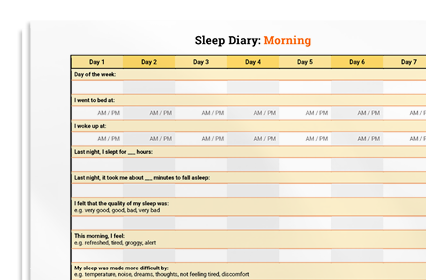
worksheetSleep problems are a common and disruptive symptom of mental illnesses that are often overlooked. Sleep deprivation can contribute to moodiness, high blood pressure, poor concentration, the prolongation of mental illness, work difficulties, auto accidents, and more. Whether the problem is insomnia, hypersomnia, or something else, a Sleep Diary is an essential tool for tracking sleep, and any factors that might be contributing to disturbances...Managing ADHD
worksheetADD / ADHD isn't just about difficulty at work or school—it also contributes to reduced self-esteem, troubled relationships, and even the likelihood of automobile accidents. Thankfully, a little bit can go a long way in the treatment of ADHD. For some, becoming aware of weaknesses, and developing strategies to counter them, can result in big improvements...Time Management Tips
worksheetBasic life skills like time management are sometimes overlooked in psychotherapy. In some cases, skills like these make all the difference. Poor time management can damage relationships or careers, and cause unnecessary stress. The Time Management Tips printout is exactly what you think it would be—a list of advice that your clients can use to improve how they manage their time...Substance Use Assessment
worksheetThe treatment of addictions typically begins by gathering a comprehensive history of a client's substance use. We've created a tool—the Substance Use Assessment—to help speed up this process, and ensure that you're asking some of the most important questions related to addiction. This tool was designed to be completed by your clients prior to a complete psychosocial assessment...Addiction Discussion Questions
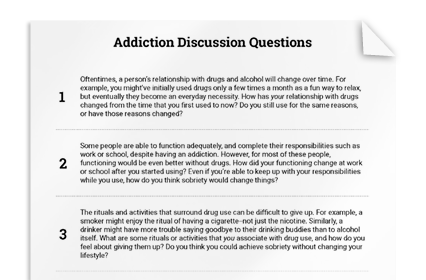
worksheetGroup discussion about drugs and alcohol can help your clients bond, develop insight, build motivation for change, and learn about addiction from the experiences of others. The Addiction Discussion Questions worksheet was designed to encourage deeper conversation about addiction through the use of open-ended questions that require some thought...The Grieving Process
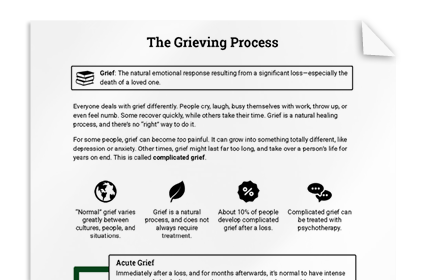
worksheetGrief is a natural process that's painful, personal, and normal. Grief allows a person to come to terms with a significant loss, and make sense of their new reality without a loved one. In most cases, grief will resolve itself with the passage of time, and psychotherapy is unnecessary. Other times, grief can become complicated and fail to resolve...The CBT Model: Psychoeducation
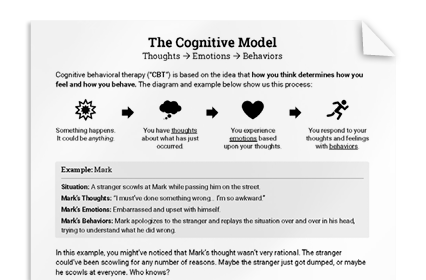
worksheetTeaching the cognitive model often serves as an introduction to CBT, and your client's understanding of the model can set the tone for the rest of therapy. Does the model resonate with your client, or does it seem confusing and irrelevant? The CBT Model Info Sheet is a one-page worksheet designed to explain the cognitive model through accessible writing and examples...Boundaries Exploration
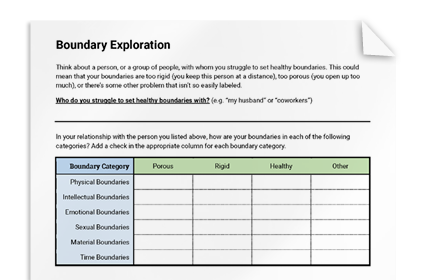
worksheetGuide your clients in the exploration of their relationship boundaries with the Boundaries Exploration worksheet. In this activity, your clients will be asked to think of a particular relationship, and the quality of their boundaries within that relationship. The second half of the worksheet asks questions that are designed to help your client begin considering ways to improve their boundaries...





Subscribe to:
Posts (Atom)